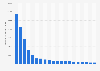
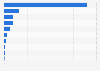
Buy now, pay later (BNPL) has secured its place as a distinct layer within the global payments ecosystem. BNPL's share in global e-commerce stood at four percent of total e-commerce transaction value worldwide in 2025, a figure that underplays wide regional variation; Europe registered nine percent and North America six percent. China led all BNPL markets worldwide in 2025 with 143.3 billion U.S. dollars in transaction value, followed by the United States at 107.4 billion U.S. dollars and Germany at 71.6 billion U.S. dollars.
Asia-Pacific and Europe drive global BNPL volume
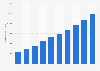
Between 2022 and 2025, both Asia-Pacific and Europe roughly doubled their BNPL transaction volumes. Asia-Pacific reached 223.4 billion U.S. dollars in BNPL volumes in Asia-Pacific in 2025, up from 115.8 billion U.S. dollars in 2022. Europe followed with 182.1 billion U.S. dollars in BNPL spending across the continent in 2025, up from 92.1 billion U.S. dollars in 2022.
Klarna dominates a fragmented competitive field
118 million active users. That is Klarna's lead position among
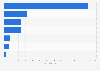
global BNPL providers as of March 2026, more than three times the 32 million reported by second-placed PayPal Pay Later, and well ahead of Afterpay and Affirm at 24 million and 23 million active users, respectively. Country-level data on
BNPL use across countries in 2025 shows Sweden, Finland, and Norway recording shares of 25 percent, 19 percent, and 19 percent of domestic e-commerce payments, respectively, against a global average of four percent. That concentration in the Nordic markets may reflect Klarna's origins and the density of its regional merchant network.
BNPL becomes a structural fixture in payments
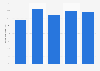
Consumer BNPL adoption in the United States grew from 10 percent of adults in 2021 to 15 percent in 2024, then settled into a 13.8 to 15.4 percent range across monthly readings in 2025. Stabilization at that level is not a warning sign. The United States is forecast to reach 258.4 billion U.S. dollars in
annual U.S. BNPL spending by 2031, more than doubling from its 2025 level. What the data describes, across regions, is a payment method that has moved past the adoption curve and into the checkout infrastructure of global commerce. BNPL is no longer competing for shelf space alongside credit cards; in several markets, it has already taken it.
This text provides general information. Statista assumes no
liability for the information given being complete or correct.
Due to varying update cycles, statistics can display more up-to-date
data than referenced in the text.