Electric vehicles in the United States - statistics & facts
The electric vehicle (EV) market in the United States currently finds itself at a crossroads. The last decade has seen the segment go from being a niche part of the automotive industry to a considerable force, with the annual sales of plug-in electric light vehicles in the U.S. going from around 18,000 units sold to over 1.56 million. However, the momentum driving this growth - improved battery technology, larger model lineups, and incentive policies - hit a roadblock. In 2025, sales declined by nearly four percent from 2024, and, most tellingly, the monthly market share of battery-electric vehicles' (BEV) went from 12 percent in September 2025 to around six percent in June 2026.
What has caused the demand for EVs in the U.S. to drop?
One likely reason the demand for EVs in the U.S. decreased at such a rapid rate after September 2025 was the reduction of government-backed incentives during the first two years President Trump’s second term. The scrapping of the tax credits included in the 2022 Inflation Reduction Act (IRA), effective from September 30, 2025 onwards, for instance saw prospective EV buyers lose out on a reported 7,500 U.S. dollar tax break. This is especially significant when considering the relative lack of EVs priced under 40,000 U.S. dollars in comparison to internal combustion engine vehicles (ICEV).
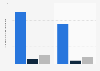
Cost, however, is not the only concern among consumers — driving range and the time required to charge remain persistent barriers to adoption. With 45 percent of the U.S. population living within one kilometer of an electric vehicle charger in 2024, compared to 81 percent in Germany and 78 percent in the United Kingdom, these concerns are certainly not unfounded.
California and Tesla define a highly concentrated market
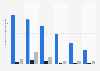
Another challenge that the EV market in the U.S. has faced is diversification, both geographically and company-wise. When it comes to the U.S. states with the most battery electric vehicle registrations, California had over a third of the national total in 2024. This dominance was also reflected in the number of private and public EV charging stations in California as of November 2025 – the Golden State was home to 18,644 charging locations, which was more than triple the figure for the state of New York, which had the second-highest number of locations.
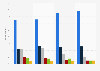
Meanwhile, on the company front, Tesla towers over every other car brand when it comes to EV sales in the United States. In 2025, Tesla sold an estimated 589,160 units, which was around double the aggregate amount sold by its four biggest competitors – Chevrolet, Ford, Hyundai, and Cadillac. Making up the largest share of Tesla sales that year was the Model Y, which sold over 350,000 units.
What does the future hold for the U.S. EV market?
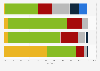
While the recent stagnation of the EV market in the U.S. has shown its susceptibilities, projections in January 2026 still forecast a steady growth in sales between 2026 and 2031. One factor that could contribute to this expected growth is the changing preferences among younger generations when it comes to alternatives to gasoline-powered vehicles. When surveyed in 2025, Gen Z and Millenial respondents both showed a higher likelihood of considering electric or hybrid car models than older age groups. Whether that generational momentum can overcome the challenges of diminishing financial incentives and a relative lack of charging spots, however, remains to be seen.